ITALY – FERRARA II

Our time in Ferrara continues…

[Remember - clicking on images will open them in a new window/tab - all images are also geo-tagged]

Medieval Bike Rack (?), Castello Estense, Ferrara, Emilio-Romagna, Italy


Stone Cannonballs, Courtyard, Castello Estense, Ferrara, Emilia-Romagna, Italy


Passageway, Castello Estense, Ferrara, Emilia-Romagna, Italy


Courtyard Wells, Castello Estense, Ferrara, Emilia-Romagna, Italy


Castello Estense di Ferrara, Lungo Castello, Ferrara, Emilia-Romagna, Italy


Passageway, Castello Estense, Ferrara, Emilia-Romagna, Italy


Bas Relief, Torre San Paolo, Castello Estense, Piazzetta del Castello, Ferrara, Emilia-Romagna, Italy


Corso Martiri della Libertà, Ferrara, Emilia-Romagna, Italy


Torre dell’Orologio & Torre della Vittoria, Corso Martiri della Libertà, Ferrara, Emilia-Romagna, Italy


Tree, Rotonda Foschini, Corso della Giovecca, Ferrara, Emilia-Romagna, Italy


Coat of Arms, Palazzo Bentivoglio, Via Giuseppe Garibaldi, Ferrara, Emilia-Romagna, Italy


Volto del Cavallo, Piazza del Municipio, Ferrara, Emilia-Romagna, Italy

Passageway between Piazza Cattedrale & Piazza del Municipio.


Barred Window, Volto del Cavallo, Piazza del Municipio, Ferrara, Emilia-Romagna, Italy


Chiesa di Gesù, Via Borgo dei Leoni, Ferrara Emilia-Romagna, Italy

It was built for the Jesuit Fathers in 1570. Following the suppression of the Society of Jesus in 1773, the church and college were entrusted to the Somask fathers. In 1933 Archbishop Ruggero Bovelli transferred the Priory of St. Michael to the church of Jesus. He assumed the name of St. Michael in Jesus. The church was damaged during the bombings of 1944. In 1986 the parish once again modified the name from “Saint Michael in the Jesus” to the current one


Mailbox, Piazza Torquato Tasso, Ferrara, Emilia-Romagna, Italy


Rusted Supports, 6 Piazza Torquato Tasso, Ferrara, Emilia-Romagna, Italy


Statue, Banco D’Italia, Cnr Corso Ercole d’Este & Piazza Torquato Tasso, Ferrara, Emilia-Romagna, Italy


Doorway, Camera di Commercio di Ferrara, Viale Cavour, Ferrara, Emilia-Romagna, Italy

Camera di Commercio di Ferrara = Chamber of Commerce of Ferrara


Street Lamp, Viale Cavour, Ferrara, Emilia-Romagna, Italy


Lamp, Via Giovanni Boldini, Ferrara, Emilia-Romagna, Italy


Chiesa San Carlo Borromeo, Via Giovanni Boldini, Ferrara, Emilia-Romagna, Italy


Carabinieri, Corso Martiri della Libertà, Ferrara, Emilia-Romagna, Italy


Guard Duty, Piazza Savonarola, Ferrara, Emilia-Romagna, Italy


Sebastian Pub, Party Boat, Bar & Pizzeria, Canale di Burana, Ferrara, Emilia-Romagna, Italy


Portico, Castello Estense, Ferrara, Emilia-Romagna, Italy


Chiaroscuro Images, Castello Estense, Ferrara, Emilia-Romagna, Italy

These images dated 1577 represent a mythological cycle of the Este family.


ITALY – FERRARA I

After out time in Siena, we travelled by train to the town of Ferrara in the province of Emilia-Romagna where we spend the next 4 days.


[Remember - clicking on images will open them in a new window/tab - all images are also geo-tagged]

Overgrown Gate, Via Darsena, Ferrara, Emilia-Romagna, Italy


Mazzanto e C, Via Bologna, Ferrara, Emilia-Romagna, Italy


Scultura di Mario Piva, Junction of Via Bologna & Via John Fitzgerald Kennedy, Ferrara, Emilia-Romagna, Italy


The Porta Paola, Via Donatori di Sangue, Ferrara, Emilia-Romagna, Italy

Built in 1612, Porta Paola is the largest monumental arch and passageway in the city today, greatly enhanced by its imminent new use as a Documentation Centre for the City Walls.


Wall, Via Donatori di Sangue, Ferrara, Emilia-Romagna, Italy


Fondaco del Mercanti Medioevali, Via Delle Volte, Ferrara, Emilia-Romagna, Italy

Fondaco del Mercanti Medioevali – Medieval Merchants’ Warehouse


Is It Art, 62 Corso Porta Reno, Ferrara, Emilia-Romagna, Italy


Arched Passageway, Piazetta Alberto Schiatti, Ferrara, Emilia-Romagna, Italy


Torre dellÓrologio & Porto Reno, Corso Porta Reno, Ferrara, Emilia-Romagno, Italy


Via del Podestà, Ferrara, Emilia-Romagna, Italy


Cattedrale di Ferrara di San Giorgio Martire, Piazza della Cattedrale, Ferrara, Emilia-Romagna, Italy

The cathedral was begun in 1135 and dedicated to St. George. The main altar was consecrated on 8 May 1177, and this confirms that 42 years after the laying of the first stone the eastern part was almost complete.


Torre dell’Orologio, Piazza Trento-Trieste, Ferrara, Emilia-Romagna, Italy

The Clock Tower was built in the second half of the 16th century, when the Bell of Reason was placed. In 1603 a structural restoration of the Tower was necessary and the task was given to the architect Gian Battista Aleotti. In 1864 the Clock with the luminous dial was added.  The Clock Tower is also called Torre Aleotti.


Torre della Vittoria, Piazza della Cattedrale, Ferrara, Emilia-Romagna, Italy

As part of the action aimed at recovering and enhancing the city’s building heritage, begun in the early 1920s, in Ferrara, which began with the restoration of two public buildings that are emblems of the city, namely the Castello Estense and the Palazzo Municipale, radical work was carried out on the latter’s façade, the one facing the Duomo. In particular, a new Tower of Victory was erected to replace the original one, designed by Rigobello, which had collapsed during the seventeenth century, in 1570, at the beginning of the seismic swarm that struck the city until 1574.

Built on a 14th-century model, in Gothic style and with materials reminiscent of the Este Castle, it is 57 m high and the top is crenellated, like the reconstructed façade of the Town Hall.


Stone Lion, Cattedrale di Ferrara, Piazza della Cattedrale, Ferrara, Emilia-Romagna, Italy


Equestrian Statue of Nicolo lll, Corso Porto Rena, Piazza della Cattedrale, Ferrara, Emilia-Romagna, Italy


Girolamo Savonarola, Piazza Savonarola, Corso Martiri della Libertà, Ferrara, Emilia-Romagna, Italy

Plaque Reads:-

GIROLAMO SAVONAROLA IN CORRUPT AND SERVILE TIMES OF VICES AND TYRANTS FLAGELLATORE

Girolamo Savonarola (1452-1498) was born into a noble family in Ferrara, his father being a doctor. Girolamo was educated by another relative who was also a doctor and a man of rigid religious principles. So it was inevitable that the young lad would be directed towards medicine at university and devout Christianity at home.

Already repelled by the corruption that he saw around him, Savonarola left his medical studies and withdrew into solitude, meditation and prayer. He told his father that he could not suffer the blind wickedness of the peoples of Italy. He found unbearable the humanistic paganism that corrupted art, poetry and religion itself. But even if that was so, how did young Savonarola know that the cause of this spreading corruption was a vicious clergy, even in the highest levels of the church hierarchy?

In 1475 as an adult he chose to enter a Dominican monastery at Bologna. After living quietly there for 6 years, Savonarola moved to the convent of S Marco in Florence and began preaching in the church of S Lorenzo. His style, too medieval and scholastic, failed to attract the crowds. But in 1486, while preaching in Lombardy, he began to speak directly and passionately of the wrath of God. His popularity as a preacher grew immensely.

Savonarola’s fame spread to Florence as he prophesied the doom of all tyrants who then prevailed in the world. In 1490, through the influence of Pico della Mirandola, he moved back to Florence and in July 1491 became prior of S Marco. His target evils in beautiful Florence were the vanity of the humanists and the viciousness of the clergy. Needless to say Lorenzo de’ Medici, the ruler of Florence, was not happy with the fanatical preacher. But Savonarola would not desist, and in April 1492 Savonarola made his move – he refused to grant Lorenzo absolution because the ruler would not give liberty to the Florentines.


Cobble Stones, Piazzetta del Castello, Castello Estense, Ferrara, Emilia-Romagna, Italy


Colubrina detta _La Regina, Piazzatta del Castello, Castello Estense, Ferrara, Emilia-Romagna, Italy

“The Queen” is a faithful, life-size copy of the ancient culverin, weighing over seven tons, made in 1556 by Annibale Borgognoni for the lord of Ferrara, Duke Ercole II d’Este, exhibited in the Piazza Castello in Ferrara.


Castello Estense di Ferrara, Piazzatta del Castello, Castello Estense, Ferrara, Emilia-Romagna, Italy

The Estense Castle was built in 1385, as a fortress for political and territorial military control and for the defense of the Este family, therefore also thought of as a repressive tool against possible revolts. The first stone was laid symbolically on September 29, the day of St. Michael, warrior archangel at the head of the celestial militias.

See history at Wikipedia:


Enclosed Window, Castello Estense, Piazzetta del Castello, Ferrara, Emilia-Romagna, Italy


Moat, Castello Estense di Ferrara, Piazzatta del Castello, Ferrara, Emilia-Romagna, Italy


Entrance Gates, Castello Estense di Ferrara, Piazzatta del Castello, Ferrara, Emilia-Romagna, Italy


Torch Holder in Entrance, Castello Estense di Ferrara, Piazzatta del Castello, Ferrara, Emilia-Romagna, Italy


Units of Measurement Plaque, Estense Castle, Ferrara, Emilia-Romagno, Italy

After what was at the time the drawbridge and before entering the inner courtyard of the castle, on the left there is a bas-relief with 4 horizontal iron lines.

Each of those strips represented a unit of measurement used in the city. At the time there were no portable meters, much less laser measurements, so the citizens, to measure something, could go inside the castle and were sure not to be wrong even a centimetre.

The measurements referred to the feet and arms, and these words on the slab are still visible.


Memorial Plaque, Piazza Savonarola, Ferrara, Emilia-Romagna, Italy


Monumento a Ludovico Ariosto, Piazza Ariostea, Ferrara, Emilia-Romagna, Italy

8 September 1474 – 6 July 1533) was an Italian poet. He is best known as the author of the romance epic Orlando Furioso (1516). -[never heard of either…:) ]


Discarded Apple, Piazza Trento – Trieste, Ferrara , Emilia-Romagna, Italy


Order of Architects P.P.C. of the Province of Ferrara, Corso Isonzo, Ferrara, Emilia-Romagna, Italy


Drogheria Bazzi & C. – Taverna con Bottega, Piazza del Municipio, Ferrara, Emilia-Romagna, Italy

We enjoyed a couple of evening meals here!


ITALY – SIENA II

More shots from Siena

IHS Christogram, Palazzo Publico, Piazza del Campo, Siena, Tuscany, Italy


Date Clock, Torre del Mangia, Palazzo Publico, Piazza del Campo, Siena, Tuscany, Italy

San Pietro in Castelvecchio, Via San Pietro, Siena, Tuscany, Italy

Loggia della Mercanzia, Via di Città, Siena, Tuscany, Italy

Two statues on the outer pillars of the loggia depict St. Peter and St. Paul and are from Vecchietta (1458 - 1462); the other three statues depict three of the four ancient patron saints of the city, San Savino, Sant'Ansano and San Vittore, and are by Antonio Federighi (1458-1459). (not all included here)

Entrance, Palazzo Chigi Zondadari, Banchi di Sotto, Siena, Tuscany, Italy

Duomo di Siena, Piazza del Duomo, Siena, Tuscany, Italy

Old Staircase, Museo Archeologico Nazionale, Piazza del Duomo, Siena, Tuscany, Italy

  Exhibits Beneath Museo Archeologico Nazionale, Piazza del Duomo, Siena, Tuscany, Italy

 Beneath Museo Archeologico Nazionale, Piazza del Duomo, Siena, Tuscany, Italy

Doorway, 18 Via Fusari, Siena, Tuscany, Italy

Courtyard, La Terrazza Sul Campo, Via di Città, Siena, Tuscany, Italy

Passageway, Via di Città, Siena, Tuscany, Italy

Wine Shop, Via di Città, Siena, Tuscany, Italy

Key Hole & Knocker, Via dei Pellegrini, Siena, Tuscany, Italy

Cellar Stairs, Il Battistero Siena Residenza d' Epoca, Piazza San Giovanni, Siena,Tuscany, Italy

The four-storey Il Battistero Siena Residenza d' Epoca is an historic palace on St. Giovanni Square in front of the Cathedral Baptistery. A Pope, famous authors, artists and architects have all stayed here. Below the Palace and Square is a stone cellar and medieval aqueduct – a secret path once used by Pope Alexander VII.

Morning Frost, Via Fosso di Sant'Ansano, Siena, Tuscany, Italy

A New Friend, Via di Città, Siena, Tuscany, Italy

Stone Framed Window, Via dei Pittori, Siena, Tuscany, Italy

Old Statue, Palazzo Pubblico, Piazza del Campo, Siena, Tuscany, Italy

Torre del Mangia, Palazzo Pubblico, Piazza del Campo, Siena, Tuscany, Italy

Window & Arch, Palazzo Pubblico, Piazza del Campo, Siena, Tuscany, Italy

Ferro di Facciata, Palazzo Pubblico, Piazza del Campo, Siena, Tuscany, Italy

RP 1746, Piazzetta dell'Indipendenza, Siena, Tuscany, Italy

Unity Commemoration, Piazzetta dell'Indipendenza, Siena, Tuscany, Italy

Bust, Piazzetta dell'Indipendenza, Siena, Tuscany, Italy

ITALY – SIENA I

The next leg of our journey is spending four nights in Siena, staying in a wonderful old building that once accommodated popes.


Basilica Cateriniana San Domenico, Piazza San Domenico, Siena, Tuscany, Italy


Battistero di San Giovanni Battista, Piazza San Giovanni, Siena, Tuscany, Italy

Siena Baptistery of San Giovanni – built between 1316-1325. This is right outside our front door.


Bust of Francesco di Giorgio Martini, Piazza San Giovanni, Siena, Tuscany, Italy

Francesco di Giorgio Martini…1439-1501 was an Italian architect, engineer, painter, sculptor, and writer.


Stairs, Il Battistero Siena – Residenza d’epoca, Piazza San Giovanni, Siena, Tuscany, Italy


Old Door, Piazza Del Duomo, Siena, Tuscany, Italy


Doorway, Via Del Capitano, Siena, Tuscany, Italy


Hand Painted Ceramic Plate, Ceramiche Antica Siena, 29 Il Campo, Siena, Tuscany, Italy


Fountain & Christmas Tree, Piazza di Postierla, Siena, Tuscany, Italy


Costa Larga, Siena, Tuscany, Italy

See Google Street View


Wall Point, Via di Città, Siena, Tuscany, Italy

See Google Street View


Vicolo di Tone, Via di Città, Siena, Tuscany, Italy


Statue of Pope Julius III, Chigi Saracini Palace, Via di Città, Siena, Tuscany, Italy


Water Well, Santuario Casa di Santa Caterina, Costa Sant’Antonio, Siena, Tuscany, Italy


Door, Palazzo Chigi Saracini, Via di Città, Siena, Tuscany, Italy


Chiasso del Bargello, Siena, Tuscany, Italy


Historic Building, Siena, Tuscany, Italy


Ferro di Facciata, Via dei Pellegrini, Siena, Tuscany, Italy


Ditta Lombardi, Piazza del Campo, Siena, Tuscany, Italy


Palazzo Pubblico, Piazza del Campo, Siena, Tuscany, Italy

The Town Hall


Piazza del Campo, Siena, Tuscany, Italy

This is the site where the Palio di Siena is held twice yearly


Romulus & Remus, Palazzo Publicco, Piazza del Campo, Siena, Tuscany, Italy


Security Patrol, Piazza del Campo, Siena, Tuscany, Italy

These patrols are everywhere you go in Italy


Former Taverna, Via Sant’Agata, Siena, Tuscany, Italy


View over Town, Via di Fontarella, Siena, Tuscany, Italy

The church tower in the distance is San Clemente in Santa Maria dei Servi


San Pietro in Castelvecchio, Via San Pietro, Siena, Tuscany, Italy

Initially built in the 12th century, this parish church was completely rebuilt in a Baroque style in the 17th century; the brick facade has a portal with a depiction of Glory of St Peter. The belltower dates to 1699, and the facade to 1706.


Exhibit, Museo Archeologico Nazionale, Piazza del Duomo, Siena, Tuscany, Italy


ITALY – PISA III

Clicking on an image will open it in a new Tab/Window.

Birthplace of Vincenzo Galilei at the junction of Via Mercanti & Borgo Stretto in Pisa, Italy

Vincenzo Galilei (3 April 1520, c. 1520, or late 1520s – buried 1 or 2 July 1591) was an Italian lutenist, composer, and music theorist, and the father of astronomer and physicist Galileo Galilei and the lute virtuoso and composer Michelagnolo Galilei. He was a seminal figure in the musical life of the late Renaissance and contributed significantly to the musical revolution which demarcates the beginning of the Baroque era.

In his study of pitch and string tension, Galilei produced perhaps the first non-linear mathematical description of a natural phenomenon known to history. It was an extension of a Pythagorean tradition but went beyond it. Many scholars credit him with directing the activity of his son away from pure, abstract mathematics and towards experimentation using mathematical quantitative description of the results, a direction of utmost importance for the history of physics and natural science.


Originally built from 1440 & reconstructed after taking damage, this fortress now houses a garden


Inscription:

A ULISSE DINI
MATEMATICO INSIGNE
ONORE DELLO STUDIO PISANO
GLORIA D’ITALIA
CITTADINO BENEMERITO
PISA RICONOSCENTE
1845-1918».

Translation:

TO ULISSE DINI
NOTABLE MATHEMATICIAN
HONOR OF PISAN STUDY
GLORY OF ITALY
WORTHY CITIZEN
GRATITUDE OF PISA
1845-1918


Part of the Museo delle Sinopie used as the ticket office for the attractions.


Constructed in 1278, the Camposanto was established to safeguard the burial sarcophagi that were in the Cathedral in a new building. As such, it has a collection of sarcophagi from Roman, medieval, and Renaissance times. It is decorated with an amazing collection of frescoes that you can see reconstructed in pictures in the museum. It was one of the first burial structures that became a museum.


Taken from the upper dome of the Baptistery.


This pulpit dating to 1310, survived a fire in 1595. Having been packed away during the redecoration, it was not rediscovered and restored until 1926. The pulpit is supported by plain columns (two of which are mounted on lion’s sculptures) on one side and by caryatids and a telamon on the other: the latter represent Saint Michael, the Evangelists, the four cardinal virtues flanking the church, and a bold, naturalistic depiction of a naked Hercules. A central plinth with the liberal arts supports the four theological virtues.

The present-day pulpit is a reconstruction of the original. It does not lie in its original position, which was nearer the main altar, and the columns and panels are not original. The original stairs (perhaps of marble) were lost.


Construction began on 17 April 1565 in order to build a church for the Order of Knights of St Stephan, founded by the Grand Duke Cosimo de’ Medici to fight Saracen piracy in the Mediterranean.


A long history dating to1061 but is now the official church of the University of Pisa.


Grand Duke Pietro Leopoldo bought this tower in 1785 and merged a new bell by Alessandro Tognozzi to mark the hours of study for the students of the University, starting at 7.30 in the morning.

The bell was inscribed:-

Audite disciplinam et et estote sapientes.

Translated:- Hear instruction and be wise.


Cassetta Per le Lettere = Mailbox


ITALY – PISA II

Ruins of Largo del Parlascio, Largo Parlascio, Pisa, Tuscany, Italy


Porta a Lucca, Largo Parlascio, Pisa, Tuscany, Italy


Monument to Paolo Savi, Orto e Museo Botanico, Via Roma, Pisa, Tuscany, Italy


26-28 Via Santa Maria, Pisa, Tuscany, Italy


Dingy Lane, Via Santa Maria, Pisa, Tuscany, Italy


Across the River Arno, Lungarno Antonio Pacinotti, Pisa, Tuscany, Italy


Ponte Solferino, River Arno, Pisa, Tuscany, Italy


River Arno, Ponte Solferino, Pisa, Tuscany, Italy


Vicolo del Ricciardi, Lungarno Gambacorti, Pisa, Tuscany, Italy

[“Vicolo” = Alley]


Vicolo del Mecherini, Lungarno Gambacorti, Pisa, Tuscany, Italy


Lungarno Gambacorti, Pisa, Tuscany, Italy


Ponte Mezzo, River Arno, Pisa, Tuscany, Italy


Palazzo Pretorio, Piazza XX Settembre, Pisa, Tuscany, Italy


Logge dei Banchi, Piazza XX Settembre, Pisa, Tuscany, Italy


River Arno, Ponte di Mezzo, Pisa, Tuscany, Italy


Palazzo Pretorio (L) & Logge dei Banchi(R), Piazza XX Settembre, Pisa, Tuscany, Italy


Alfresco Dining, Vicolo del Vigna, LLungarno Antonio Pacinotti, Pisa, Tuscany, Italy


Cinema Lumiere, Vicolo del Tidi, Lungarno Antonio Pacinotti, Pisa, Tuscany, Italy


Shutter of Closed Shop, Via Bernardo Tanucci, Pisa, Tuscany, Italy


Via Santa Maria, Pisa, Tuscany, Italy


Torre di Pisa, Piazza del Duomo, Pisa, Tuscany, Italy


Ferro di Facciata, Via Santa Maria, Pisa, Tuscany, Italy

[Used in medieval time for tethering horses – see more]


Chiesa di San Sisto, Piazza Francesco Buonamici, Pisa, Tuscany, Italy

[Constructed between 1087 and 1133]


Stone Bordered Doorway, Chiesa di San Sisto, Via Corsica, Pisa, Tuscany, Italy

Stone Bordered Doorway, Via Corsica, Pisa, Tuscany, Italy


Vintage Street Lamp, Cnr Via Ulisse Dini & Via delle Sette Volte, Pisa, Tuscany, Italy


Street Lamp, Borgo Street, Pisa, Tuscany, Italy


ITALY – PISA

We caught a train from Rome to begin the planned part of our holiday. We will spend the next four nights in Pisa. Our hotel was wonderfully located a very short walk from the Piazza Delle Duomo.


Rooftops of Pisa, Tuscany, Italy

(Taken from the balcony of our hotel)


Cattedrale di Pisa, Piazza del Duomo, Pisa, Tuscany, Italy

(Taken from the balcony of our hotel)


Bells of Chiesa di San Giorgio dei Tedeschi, Via Santa Maria, Pisa, Tuscany, Italy

(Taken from the balcony of our hotel)


Entrance, Collegio Ferdinando, Via Santa Maria, Pisa, Tuscany, Italy

In 1593, the Ferdinand College was inaugurated at 102 via Santa Maria. The great portal in marble and the bust of the Grand Duke are works by Raffaele Pagni. Ferdinand I wanted to open its doors to all deserving students, even those who did not have the opportunity to pay for their studies.


Inner Courtyard Door, Università di Pisa – Biblioteca di Antichistica, Via Santa Maria, Pisa, Tuscany, Italy


Doorway, 2 Via dei Mille, Pisa, Tuscany, Italy


Chiesa di San Sisto, Piazza Francesco Buonamici, Pisa, Tuscany, Italy


Antica Trattoria Antonietta Pisa, Via Santa Maria, Pisa, Tuscany, Italy


The Tower at Night, Piazza del Duomo, Pisa, Tuscany, Italy


Battistero di San Giovanni & Cattedrale di Pisa, Piazza del Duomo, Pisa, Tuscany, Italy


Battistero di San Giovanni, Piazza del Duomo, Pisa, Tuscany, Italy


Entrance of Tourist Information Office, Piazza del Duomo, Pisa, Tuscany, Italy

Part of the Museo delle Sinopie used as the ticket office for the attractions.


Via Roma, Pisa, Tuscany, Italy


Fontana dei Putti, Piazza Arcivescovado, Pisa, Tuscany, Italy


Christmas Lights, Via Santa Maria, Pisa, Tuscany, Italy


Street Lamp, Via Santa Maria, Pisa, Tuscany, Italy


Battistero di San Giovanni & Leaning Tower, Piazza del Duomo, Pisa, Tuscany, Italy

(Taken from the balcony of our hotel)


Torre di Santa Maria, Via Contessa Matilde, Pisa, Tuscany, Italy


Tower Gate, Torre di Santa Maria, Via Contessa Matilde, Pisa, Tuscany, Italy


Battistero di San Giovanni, Piazza del Duomo, Pisa, Tuscany, Italy


On the Old City Wall Walkway, Pisa, Tuscany, Italy


Within The Wall, City Wall, Pisa, Tuscany, Italy


ITALY – 2024-2025

The beginning of our trip to Tuscany, Italy. We had booked flights to take us to Pisa to begin the trip and thus made all of the arrangements around this. Unfortunately, Emirates decided to remove their scheduled flight from Dubai to Pisa leaving us with a bit of a problem. We ended up having to leave a couple of days earlier than planned and fly to Rome and then catch a train to Pisa to start our holiday, hence we spent only a single day in Rome. Below is from that day.


Views of The Colosseum


Archaeological Excavation, via Luigi Petroselli, Rome, Italy


Circus Maximus, Viale Aventino, Rome, Italy


Chiesa di San Rocco all’Augusteo, Via di Ripetta, Rome, Italy

(Built between 1499 – 1832)


Chiesa del Santissimo Nome di Maria al Foro Traiano, Foro Traiano, Rome, Italy


Distressed Wall, Chiesa di San Sebastiano al Palatino, Via di San Bonaventura, Rome, Italy


Ornate Statuette Lamp. Grand Hotel Palace, Via Vittorio Veneto, Rome, Italy


Gateway, Chiesa di San Sebastiano al Palatino, Via di San Bonaventura, Rome, Italy

The site was originally for a temple built by the emperor Elagabalus in the third century. The temple was replaced by a church and an attached monastery in the tenth century. It was dedicated to the Virgin Mary, Saint Sebastian, and Saint Zoticus, which can be read in an inscription that also contains the name of the founder of monastery, a physician named “Peter”. Originally the church was known as Santa Maria in Pallara, after the Palladium, the ancient image of Athena from Troy which – along with some of the most sacred objects in pagan Rome – was allegedly kept in a pagan temple on the same site. In 1061, the church was given to the abbot of Montecassino. It was then dedicated to Saint Sebastian. The structure that stands today is the result of a rebuilding in 1624.


Terme di Elagabalo, Via di S. Gregorio, Rome, Italy

Roman Baths adjacent to The Colosseum.


Shrine, Via di San Bonaventura, Rome, Italy


Side Wall of Chiesa San Bonaventura al Palatino, Via di San Bonaventura, Rome, Italy


Ruins, via Filippo Turati, Rome, Italy


Ruins behind Circus Maximus, Viale Aventino, Rome, Italy


Overgrown Gateway, Via di San Bonaventura, Rome, Italy


Courtyard, via Cairoli, Rome, Italy


Colonnade, via Giovanni Giolitti, Rome, Italy


Colonnade, Piazza Vittorio Emanuele II, Rome, Italy


Poignant Message, Colonnade, Piazza Vittorio Emanuele II, Rome, Italy


Doorway, Frati Cappuccini (Capuchin Friars), San Fedele Convent, via Cairoli, Rome, Italy


Street Sign, Via Machiavelli, Rome, Italy


Birra Moretti IPA, Hotel Napoleon, Piazza Vittorio Emanuele II, Rome, Italy


Oops!, Via di Porta Maggiore, Rome, Italy


99 Piazza Vittorio Emanuele II, Rome, Italy


Bologna, Emilia-Romagna, Italy Part VI

Chiesa Parrocchiale di Santa Maria della Carità, Via San Felice, Bologna


Inscription, San Nicolò di San Felice, Via San Felice, Bologna

San Nicolò di San Felice is a deconsecrated Roman Catholic church located on via San Felice 41 in Bologna, region of Emilia Romagna, Italy. Bombardment during World War two caused sufficient damage to close the brick walled structure with a front portico.

A church at the site is documented since the 12th-century, when it was located outside the city walls.

CRUCEM HANC
INSIGNE REDEMPTIONIS HUMANAE VEXILLUM
A BONONIENSIBUS CIVIBUS
VIX NASCENTE ECCLESIA
IN SUSCEPTAE FIDEI ARGUMENTUM
ERECTAM
INDE SAEPIUS INIURIA TEMPORUM COLLAPSAM
ITERUMQUE PRISTINO LOCO RESTITUTAM
VESPASIANUS GRIMALDI
ALPHONSO PALEOTTO ARCHIEPI(SCOPO) BONONIEN(SI)
SUB INITIUM SUPERIORIS SECULI (!)
IN VIAE HUIUS MEDIO
SUPER PONTEM QUO FIRMIUS SUBSISTERET
COLLOCAVIT
VERUM PONTE PRO AMPLIANDA VIA DESTRUCTO
EAMDEM CRUCEM
HIERONYMO GRIMALDO S(ANCTAE) R(OMANAE) E(CCLESIAE) CARDINALI
TIT(ULO) SANCTAE BALBINAE
BONONIAE LEGATO

PROSPER LAMBERTINUS S(ANCTAE) R(OMANAE) E(CCLESIAE) CARDINALIS

TIT(ULO) SANCTAE CRUCIS IN IERUSALEM

ARCHIEPISCOPUS BONONIENSIS
SACRI ROMANI IMPERII PRINCEPS
AEMULA MAIORUM SUORUM PIETATE
SUB HAC PORTICU SACRAE HUIUS AEDIS PARIETI
AFFIGI CURAVIT
ATQUE SOLEMNI RITU BENEDIXIT
OMNIBUSQUE CORAM IPSA DEVOTE ORANTIBUS
ET PRO PATRIAE INCOLUMITATE
VOTA SUA OMNIPOTENTI DEO NUNCUPANTIBUS
CENTUM DIERUM INDULGENTIAM BENIGNE CONCESSIT
ANNO MDCCXXXII

Translation
“This cross, an extraordinary sign of human redemption, erected by the citizens of Bologna when the church was just being born in defense of the embraced faith, then very often ruined by the ravages of time and each time restored in its original place, Vespasiano Grimaldi, when it was Archbishop of Bologna Alfonso Paleotti, at the beginning of the last century, placed it in the middle of this street above the bridge, so that it could resist more firmly.
However, this bridge having been destroyed to widen the road, when Girolamo Grimaldi, cardinal of the Holy Roman Church with the title of Santa Balbina, Prospero Lambertini, cardinal of the Holy Roman Church with the title of Santa Croce in Gerusalemme, Bologna, prince of the Holy Roman Empire, took care that the same cross was affixed under this portico on the wall of this sacred building and blessed it with a solemn rite and graciously granted one hundred days of indulgence to all those who prayed devoutly in front of it and who formulated their vows to Almighty God for the salvation of the country.
Year 1732 “.


Entrance, Palazzo Buriani, Via San Felice, Bologna


Basilica di San Francesco, Piazza Malpighi, Bologna

In the foreground is one of the Tombe dei Glossatori – Historical tombs dedicated to the first university teachers.


Coat of Arms, Via Rizzoli, Bologna


Towers of Basilica di San Francesco & Colonna dell’Immacolata, Piazza Malpighi, Bologna


Chiesa del Santissimo Salvatore, Via Cesare Battisti & Via VI Novembre, Bologna


Wrought Iron Guard, Via Porta Nova, Bologna


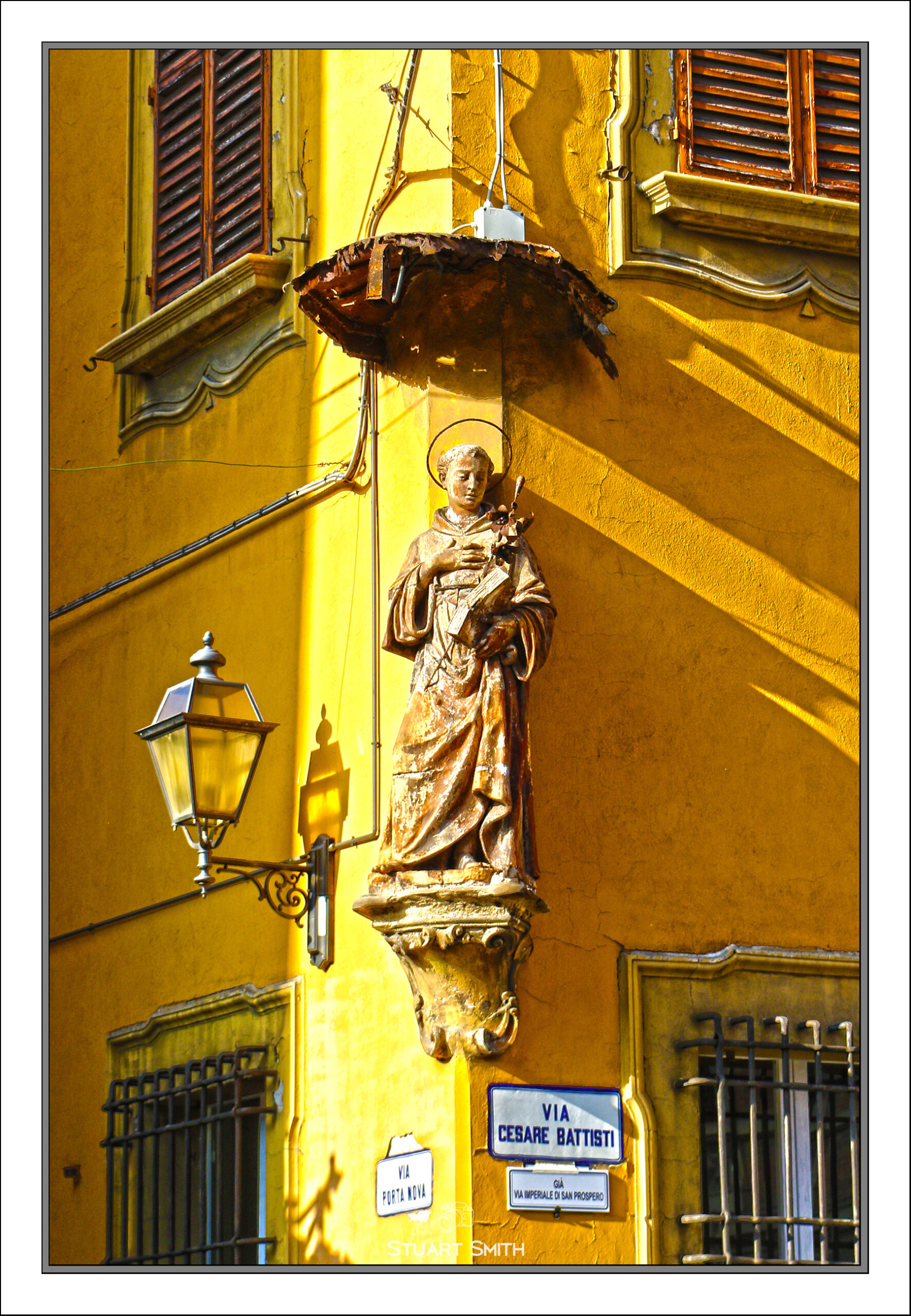
Statue of San Domenico, Cnr Via Porta Nova & Via Cesare Battisti, Bologna

Saint Dominic, also known as Dominic of Osma and Dominic of Caleruega, often called Dominic de Guzmán and Domingo Félix de Guzmán; 8 August 1170 – 6 August 1221), was a Castilian Catholic priest and founder of the Dominican Order. Dominic is the patron saint of astronomers.

The “canopy” above the statue is referred to as a “baldachin” or “baldaquin”.

The church, statues and guard are all visible on this Street View!


Entrance to Residential Block, Via Cesare Battisti, Bologna


Entrance, Palazzo del Governo, Piazza Franklin Delano Roosevelt, Bologna


Colonnade, Palazzo del Governo, Piazza Franklin Delano Roosevelt, Bologna


Colonnade, Prefettura di Bologna, Piazza Galileo Galilei, Bologna


Artwork in the Colonnade, Prefettura di Bologna, Piazza Galileo Galilei, Bologna


Santuario di Santa Maria della Vita, Via Clavature, Bologna


Salumeria Simoni, Via Drapperie, Bologna


Quadrilatero Fiorito, 6 Via Drapperie, Bologna


Carving, Doorway, 5 Via Drapperie, Bologna


Flags, Cnr Via Drapperie & Via Pescherie Vecchie, Bologna


Memorial, P Marella Padre dei Poveri, Cnr Via Caprarie & Via Drapperie, Bologna

Fr Marella Father of the Poor

This Street View shows a Monk collecting for the charity sitting in front of that memorial plate.


Stone Carving, Cnr Via Caprarie & Via Drapperie, Bologna

Sits above the Memorial to P Marella Padre dei Poveri


Basilica Santi Bartolomeo e Gaetano, Piazza di Porta Ravegnana, Bologna


Enjoy a Beer, Caffé Maxim, Piazza della Mercanzia, Bologna


Along the Colonnade, Via Rizzoli, Bologna


Along the Colonnade, Piazza della Mercanzia, Bologna, Emilia-Romagna, Italy


Piazza di Porta Ravegnana, Bologna


Strada Maggiore, Bologna

It is the only Bolognese street to have preserved the urban designation of “strada” (from the Latin sternere : “pavement”), dating back to Roman times and confirmed by the Napoleonic reform of 1801


Roadside View, A1-Autostrada del Sole, Roncobilaccio, Baragazza


Bologna, Emilia-Romagna, Italy Part V

From the Breakfast Table, Hotel San Donato, Palazzo Malvasia, Via Zamboni, Bologna


Our Hire Car, Courtyard, Hotel San Donato (Palazzo Malvasia), Bologna


Piazza di Porta Ravegnana, Bologna


Piazza Maggiore, Bologna


Piazza Re Enzo, Bologna


Palazzo del Podestà, Piazza Re Enzo, Bologna


Piazza della Mercanzia, Bologna


View Along Via Rizzoli, Bologna


Via De’ Giudei, Bologna


LaFeltrinelli Librerie, Piazza di Porta Ravegnana, Bologna

(A Bookshop)


Doorway, 1 Piazza di Porta Ravegnana, Bologna


“Spiritus Intus Alit”, Basilica Santi Bartolomeo e Gaetano, Piazza di Porta Ravegnana, Bologna

(Main doorway and bas relief each side)

The Latin Inscription “Spiritus Intus Alit” Translates as- “Spirit within sustains”

Short guide to the Basilica of Saints Bartolomeo and Gaetano


Basilica Santi Bartolomeo e Gaetano, Piazza di Porta Ravegnana, Bologna


Carabinieri Cars, Via San Vitale, Bologna


Statue Of San Petronius, Piazza Di Porta Ravegnana, Bologna

Saint Petronius was bishop of Bologna during the fifth century. He is a patron saint of the city. Born of a noble Roman family, he became a convert to Christianity and subsequently a priest. As bishop of Bologna, he built the Church of Santo Stefano.


Medieval Building, Piazza di Porta Ravegnana, Bologna


Le Due Torri: Garisenda e degli Asinelli, Piazza di Porta Ravegnana, Bologna

See Street View!


Coat of Arms, Via Rizzoli, Bologna


Biblioteca Salaborsa, Piazza del Nettuno, Bologna


Gated Entrance, Palazzo Re Enzo, Piazza del Nettuno, Bologna

Take a Tour Inside


Ornate Street Lamp. Piazza del Nettuno, Bologna


Fontana Vecchia, Via Ugo Bassi, Bologna

By Sicilian Artist Tommaso Laureti 1565


Entrance, Cattedrale Metropolitana di San Pietro, Via dell’Indipendenza, Bologna


Staircase, Via dell’Indipendenza, Bologna


“Libertas”, Cnr Via Ghirlanda & Via Ugo Bassi, Bologna

(This sits above what is now a menswear shop)


Banco di Roma Clock, Via Ugo Bassi, Bologna


Hotel Carosello (B&B), 26 Via San Felice, Bologna


Arcade, 48 Via San Felice, Bologna


Doorway, Chiesa Parrocchiale di Santa Maria della Carità, Via San Felice, Bologna


Porta San Felice, Piazza di Porta San Felice, Bologna

Porta San Felice was the westernmost gate or portal of the former outer medieval walls of the city of Bologna, Italy. The gate was erected in the 13th century, and rebuilt in 1334 with a machiocolated tower and drawbridge. It was restored in 1508, and again in 1805 when Napoleon visited the city. In 1840, the flanking walls were torn down. A barracks and tax house for collecting duties was in the past found astride the entrance.


Doorway, 137 Via San Felice, Bologna


Door Furniture, 121 Via San Felice, Bologna